

How Much Hair Does a Wig Need? Why Too Much Looks Fake
In short: Full wigs start at 100 g, with 200 to 300 g being typical; toppers and ponytails use 100 to 175 g. Too much hair is the most common reason a wig looks fake, and long lengths from about 70 cm need more volume for the same look. At EchtHaar Direkt you choose the hair amount yourself in the configurator, and full wigs are available from 100 g.
When it comes to wigs, people almost always talk about length and color. But the question that decides whether a wig looks natural or put on is a different one: how much hair is actually in it. It’s rarely asked, because with ready-made wigs you can’t answer it anyway — the amount is predetermined. This guide explains what the gram count means, why more is not better, and how to decide.

Watch the video with chapters.
What the gram count means
The amount is given in grams and simply describes the weight of the processed hair. It determines how dense the wig looks: how much scalp shows through, how heavy it feels and how full the hairline looks.
What matters here: length and amount are linked. The same gram count looks dense at 40 cm and thin at 130 cm, because the hair is spread over a much longer distance. If you want long hair and don’t increase the amount accordingly, you end up with lengths that taper to a point at the ends. If you want short hair and choose too high an amount, you get a wig that can stick out.
Why too much hair looks fake
This is the most common reason you can tell a wig is a wig — more common than the color and more common than the hairline. Natural hair isn’t equally dense everywhere. It gets thinner toward the ends, it’s finer at the temples, and for most adults it’s much less dense than advertising photos suggest.
Catalog wigs are almost always made on the full side, because a dense wig looks more impressive in a product photo. On the head, exactly that tips over into looking artificial: the hairline looks painted on, the style doesn’t move like your own hair, and in backlight the see-through quality that real hair always has is missing.
If you have fine natural hair, you’re usually better off with less — even if choosing the smaller number feels wrong when ordering.
What you can choose from with us
Because every piece is made individually for us, the amount isn’t a fixed feature of the model but your decision. These are the options available:
- 100 g · 125 g · 150 g · 175 g — for toppers, ponytails and hairpieces
- 200 g · 225 g · 250 g · 300 g — typical for full wigs, though they’re possible from as little as 100 g
In addition, there are 19 length options from 40 cm to 130 cm, each in five-centimeter steps. Very few providers offer extra-long lengths from 100 cm at all.
As a rule of thumb: the longer the wig, the more volume it needs for the same look. For short to medium lengths, the lower half of the respective range is often a better fit than you’d think.
For toppers, the area matters too
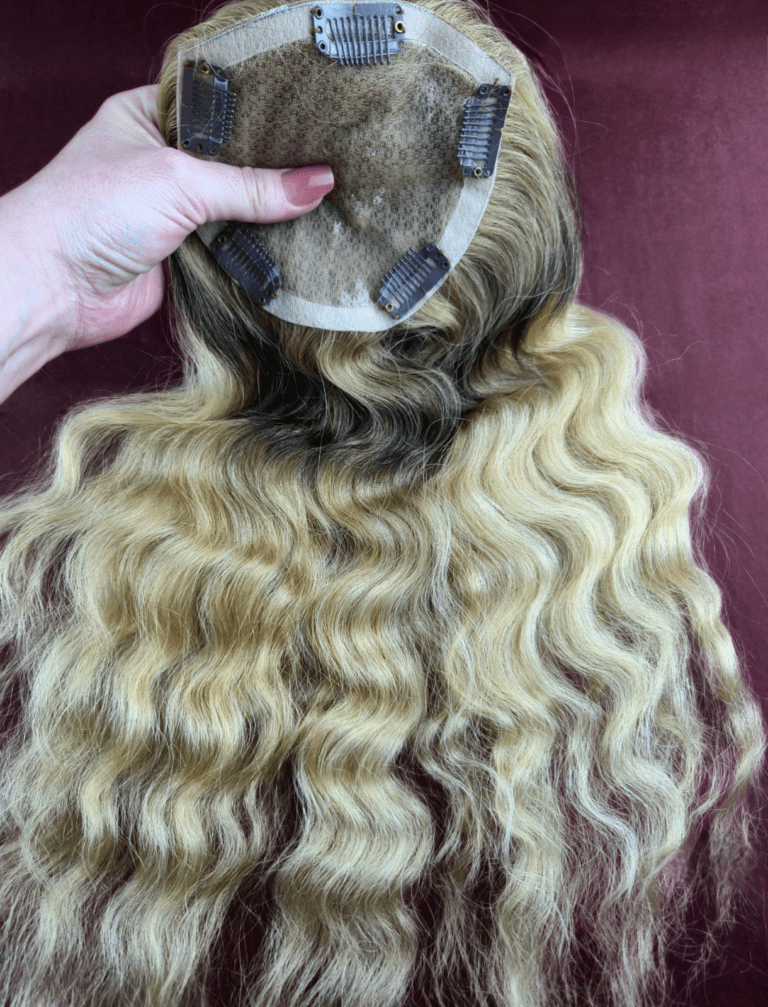
A topper covers only the top of the head, while your own hair remains visible all around. Here, alongside the quantity, the base size is what matters, and it comes in nine levels from 2,5×5 to 8×8 inches.
The base should reliably cover the thin area — but no more than that. A base that’s too large adds bulk at the edge and stands out from your own hair. That’s why it’s worth measuring the area beforehand instead of generously rounding up.
And one more point that’s often overlooked: with a hand-tied base, each hair is knotted in individually. The hairline therefore looks finer and the part can be placed more freely than with the wefted construction, where hair wefts are sewn on. If a part you create yourself is important to you, you should mention it before ordering.
How to decide
- Look at your own hair, not the hair in product photos. If it’s fine, choose less.
- Factor in the length. From about 70 cm, the same effect needs noticeably more volume.
- Think about how you want to wear it. Hair worn down shows the density more clearly than an updo.
- If in doubt, ask beforehand. A custom-made piece can’t be thinned out afterwards without losing hair.
Frequently asked questions
How many grams does a full wig need?
Full wigs are possible from 100 g, with 200 to 300 g being typical. For toppers, ponytails and hairpieces, 100 to 175 g is enough. In the configurator, amounts from 100 to 500 g are available.
Why does too much hair look fake?
Because natural hair isn’t equally dense everywhere and gets thinner toward the ends. A wig that’s too dense has a hairline that looks painted on, doesn’t move like your own hair and doesn’t let anything show through in backlight.
Does a long wig need more hair?
Yes. The same gram count looks dense at 40 cm and thin at 130 cm, because the hair is spread over more length. From about 70 cm, the same effect needs noticeably more volume.
What base size does a topper need?
2,5×5 to 8×8 inches (nine sizes), as large as necessary and no larger. The base should cover the thinning area reliably without looking bulky at the edge. Measure beforehand rather than rounding up.
Can a wig that’s too dense be thinned out afterwards?
Not without losing hair. That’s why it’s better to ask before ordering — we advise you on the right amount via WhatsApp.
In a nutshell
- The amount in grams determines the density — and with it whether a wig looks natural.
- Too much hair is the most common reason for an artificial result, not the color.
- Amount options from 100 g to 500 g, full wigs from 100 g.
- 19 lengths from 40 cm to 130 cm; longer hair needs more volume for the same look.
- For a topper, also the base size 3×5 to 5×6 inches — as large as necessary, no larger.